


The people’s church
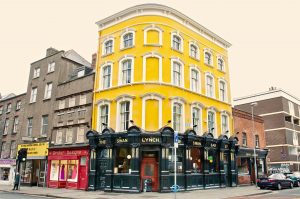
The Swan Bar on Aungier Street, Dublin 2
The summer that has passed was atypical for business in Dublin city centre. The prolonged Aer Lingus strike reduced tourism, which in turn made business unpredictable.
“We’ve felt it in Dublin. The Aer Lingus strike definitely had an impact, maybe for five or six weeks,” explains Lynch.
However, the biggest barrier to trade has been a lack of planning on the part of the event organisers and Dublin City council, it seems. The schedule of live events throughout the summer made little economic sense for businesses. Lynch says that there were a huge amount of events on, but they all took place over a few weekends. “There was one weekend where there were seven things on,” says Lynch. “We had Pride, Taylor Swift, Shania Twain, The Saw Doctors, Longitude, Croke Park and All Together Now in Blessington. There is no proper planning or thought process that goes into that happening. And then the next weekend there was nothing on. It’s totally bizarre. There needs to be some joined-up thinking.”
“Because there was so much on, people couldn’t get a cab so even if they wanted to come back into town there was no transport. People were leaving frustrated and annoyed and I don’t even think the events were making money to be honest as a lot of events were undersold.”
While trade in The Swan has managed to consistently grow with figures up on last year, their spread of customers has changed during the weeks compared with pre-Covid times. Weekends are not what they used to be and certainly Friday nights have changed irrevocably.
“We find that the Tuesday, Wednesday and Thursday (TWATS has become a phrase used to describe this phenomenon) are stronger than say Friday. When people are coming into the office, they are meeting friends for a pint after work so it’s balancing out over the week and the numbers at the end of the week are still good.
“We’ve noticed that we need all hands on deck on a Saturday around 3pm. People seem to want to go out early and go home early. Restaurants aren’t doing late sittings and people are happy to get out of town around 9.30/10pm and also people are prone to go for lunch more than dinner now. It’s just a change in how people manage their time.”
No more 12 Pubs
The Swan received attention in the press some years ago when they decided to ban the infamous annual get-togethers, The 12 Pubs of Christmas. Lynch doesn’t regret his decision and has stuck to his guns since with many other bars following suit. “We were one of the first pubs to stop the 12 Pubs because I noticed that when it came in in its infancy it was great business and people were coming in and buying a load of drinks but in essence making all the people that were in here already feeling very uncomfortable. It’s a Victorian pub so it’s not made for large groups. They were coming in and shoving the regulars out. They’d all leave after one drink and then you’d have an empty pub and you’d be left there for an hour for it to fill up again. It was unfair on the lads that come in 12 months of the year. This is a long game and it’s all about looking after our customers and making them feel comfortable and it was going against all our principles. We just felt it was prudent to do it,” he explains.
He is very conscious about nurturing his regular customers and has some who come in seven days a week. “I believe the pub is like your people’s church. Some people like to come in during the day, some in the evening but it’s part of their ritual and important to them.”
The academic staff and students from local colleges, especially The Royal College of Surgeons and DIT Aungier Street make up a big percentage of his regular customers but they play host to a lot of tourists too.
Lynch is the face of the pub and is in situ every day, despite living in Kildare. “I’m here most days,” he says. “Look if you’re passionate about a business, you never work a day in your life and I’d be very much of that mindset and I enjoy it, enjoy meeting people and being involved. Your business never runs as well when you’re not there,” he insists.
Third generation
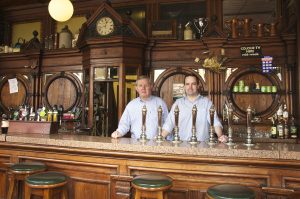
Father and son, Sean and Ronan Lynch behind the bar in their third generation family business
The story of how this pub came to be in the Lynch family is quite extraordinary, more akin to a movie than real life. “My grandfather was from Cavan and he went out to New York following his two older brothers and worked in a grocery store on 54th Street packing bags and ended up managing it. One day there was an attempted robbery and basically he levelled the guy and he didn’t finish the robbery. But it turned out that he was some Mafia guy and my grandfather was told to leave New York the next day or he’d be thrown in the river. He came back here and worked for Paul Sheehan’s grandfather, Gerry Sheehan, for a number of years in Sheehan’s Pub and saved enough money to buy here [The Swan] in 1937. He met my grandmother on the bus back down to Cavan on one of his trips home and she would have worked in the business too.”
The Swan is unique in that it’s a third-generation business, with Lynch taking over from his father and uncle in the mid 1990s. “I started working here in May 1985 when I was 12 picking up glasses. It was a different place then. Intimidating isn’t the word but you would have the old stagers sitting at the bar and they’d say, ‘I’m not taking a pint off him as he hasn’t served his time’. You had to earn your right to serve these guys. I started out cleaning ashtrays, picking up glasses, sweeping the floor and then as I got my confidence up, when I was around 15, I started pulling pints.”
Being the only boy of three children may have meant that his fate was sealed from an early age but his two younger sisters, Nicola and Ciara, would have also worked in the bar growing up. However they choose to set up their own business, a successful deli called Pickles on the Sundrive Road in Crumlin.
Career for life

The whole bar is hand-carved wood, with features like the original barrels and the cash kiosk in the middle. It has a Scottish granite counter as well and the floor is mosaic
Before Lynch took over the pub full-time, he attended university in Maynooth and subsequently went to the Michael Smurfit Business School. He also worked in banking in Dublin and Australia and hospitality in the States but he always knew the pub would be his final destination.
“My Dad and my uncle were in business together and I came in and bought the pub in 1999 and got it over the line in Feb 2000. I was only 26 at the time. Family businesses can be difficult. We all sat down together and put it in black and white where the business was going because if you want businesses to transition successfully between the generations, it’s important to ensure everyone is on the same page.”
His father Sean is 82 and is a former Ireland international rugby union player who was capped 17 times as a prop for Ireland between 1971 and 1975. He toured New Zealand in 1971 with the British and Irish Lions playing in all four tests against the All Blacks. He also played club rugby for St. Mary’s College RFC.
“Dad worked up until 2009 but he hurt his back and hasn’t worked since,” explains Lynch. “In fairness to him, he’s been very good at easing himself out of it and letting me do what I want but obviously, there is a transition period and there are differences between generations. Dad would have played rugby for Ireland on a Saturday and gone into work on the Sunday so it was a different world back then.”
Victorian building

The Swan is largely untouched retaining all the original features including this clock
The beauty of The Swan is that the building has been largely untouched over the past 100 years. “My grandparents being from Cavan didn’t spend a lot of money on it”, he jokes. It was built in 1810 and was remodelled in 1897 but there are a lot of the original features intact.
To do any renovations on the building they need to employ conservation architects and structural engineers to make sure everything is sound. Lynch says that fireproofing is an issue because these building has so much timber. “The whole bar is hand-carved wood, with features like the original barrels and the cash kiosk in the middle. It has a Scottish granite counter as well and the floor is mosaic,” he explains. This is a big draw for people who love to soak up the history and bask in the atmosphere of an old Dublin pub.
With regards drinks, this is first and foremost a Guinness pub. The other focus is on high-end whiskeys as Lynch says people will often follow a pint with a whiskey. Unusually for a pub these days, they don’t serve cocktails. “It’s not that sort of bar,” says Lynch. “We trade 70% draught. And our Guinness can fluctuate from 45% to 52% of our gross sales. So when you’re looking at that and you’re spending time making a cocktail behind a small bar, it just wasn’t viable for us to go into that space. We are putting in a whiskey menu and will be doing a couple of launches over the next few years. We have a really nice one for our 90th year in 2027,” he says.
A pub that doesn’t serve food is generally referred to as a wet pub. “We call it a traditional pub now, we don’t call it a wet pub”, corrected Lynch. “I don’t think every pub can be a Michelin Star pub. You have to balance what is right for your business. You have to read your audience. You need to have something to offer but keep it simple. We are doing a collaboration with the Dublin Pizza Company which works well for us. Moving forward we will keep it simple with sandwiches during the day. That will keep us ticking over,” he says.

“This is a long game and it’s all about looking after our customers and making them feel comfortable,” says Lynch about why they decided it was prudent to ban the 12 Pubs of Christmas groups
Covid times
Lynch was kept very busy during Covid as chair of the LVA (Licensed Vintners Association). This was an unprecedented time in business so the timing of his appointment was unlucky for him in one sense but lucky for the industry because he embraced the role and fought hard for his fellow publicans during this time. “You’re putting your industry hat on and you’re representing the publicans. I did like that side of it,” he recalls. “You’re dealing with the industry at a very precious time and you try to do your best for the industry. I felt we had a really good leadership team around us with Donall [O’Keeffe] and Noel [Anderson]. We were on our knees. We got support for the industry but it was hard fought. We were the last reopening from all the sectors and businesses are still recovering or never recovered. If you think of the last 48 months, we’ve had issues for 20 months of that and there are a lot of legacy issues that will resonate for years. That needs to be acknowledged. People took a break from their mortgages for two years as they weren’t making money but those two years need to be made up.”
Many other problems have persisted in the wake of Covid that still require attention. “We’ve had issues over wage increases, over the cost of utilities and extra bank holidays. They have all hampered the ability to do business and it has put pressure on the bottom line. We’ve had price increases of up to 20% from suppliers too. You still have to get your margin. There was such uncertainty around hospitality so pubs lost a lot of staff. They didn’t get them back. It’s very hard to pull that back.”
One positive that came from senior staff leaving is that there now lies plenty of opportunity for people who want a career in hospitality because a lot of top-tier managers moved on during Covid. “There are massive opportunities,” says Lynch. “And the door is open for young people with new ideas.”
Longstanding issues for the trade

The original taps are still on display in this Victorian bar
As we hear time and again, VAT and excise are a big issue for the drinks trade. Lynch feels this pressure of the increased VAT rate despite not having a substantial food offering. “We are a traditional pub and our food element is only 5% of our gross sales but the thing is it’s really important in other ways. By reducing the VAT, they make the restaurants more accessible to people. We need restaurants in the city centre. The more activity, the better. We’re seeing a lot of restaurants going bust. If people are not coming in to town to go to a restaurant, they are not coming here for a pint before or after and the staff aren’t coming here for a drink after work. It all has a ripple effect.
Next generation
The Swan will be in the Lynch family for 100 years by 2037, which coincides nicely with Lynch’s 65th birthday. At that point would he like one or both of his sons (now teenagers) to take over, we wondered? “Look it’s way too far ahead. They’ve their whole lives ahead of them. The reality of the situation is you’d love to see your kids go into your business. You’d be lying if you said you didn’t but it’s their choice. If they don’t want to go into it, that’s fair enough. You’d love someone to come in here and run the business with the same level of passion that you had. I was brought in here when I was 12. It was a different time then. I worked every Friday. My friends would be off to Wesley [disco] and I never went. I wouldn’t like that for them. My lads give me a hand at Christmas and they enjoy coming in but they can do what they want. That chapter is not for me to write”.